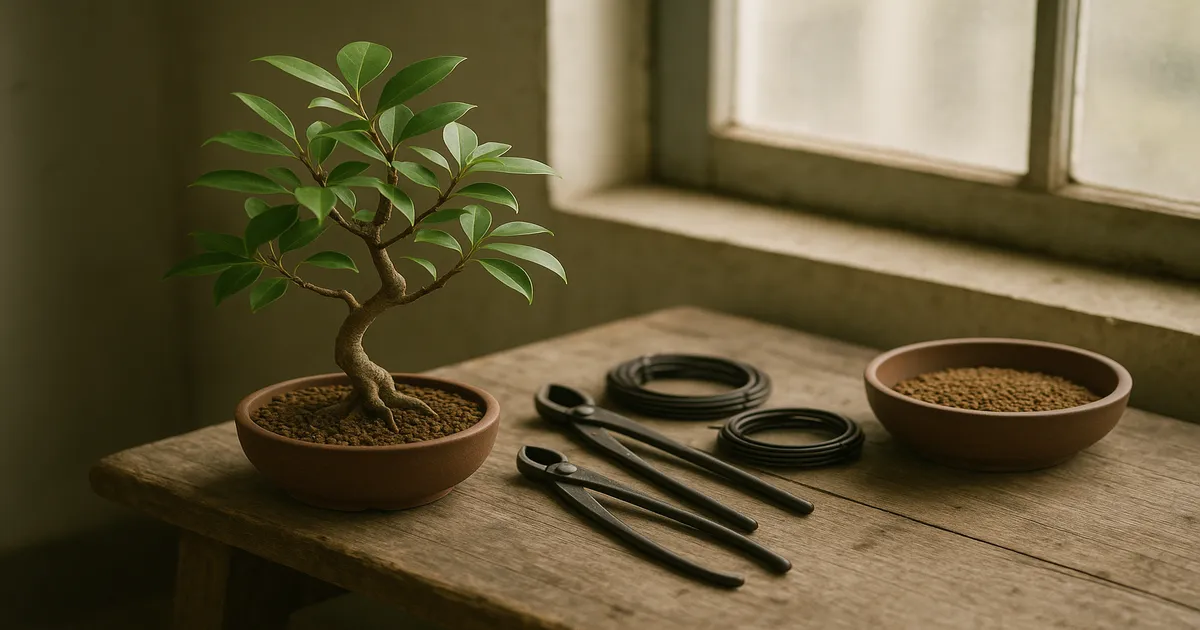
Quick Answer: Keeping a bonsai tree alive indoors long-term comes down to one foundational decision: choosing the right species. Only tropical and subtropical trees — Ficus, Carmona, Schefflera, Serissa, and Jade — genuinely thrive inside. Get the species right, then focus on adequate light, careful watering, fast-draining soil, and stable warmth, and your bonsai can live for decades.
Learning how to keep a bonsai tree alive indoors starts with an uncomfortable truth: most trees sold as “indoor bonsai” at garden centers and gift shops don’t belong inside at all. Junipers, Japanese maples, and pines are routinely labeled for indoor use, and they will slowly decline no matter how attentive you are. This guide focuses on the species that genuinely thrive indoors — and exactly how to care for them.
How to Keep a Bonsai Tree Alive Indoors: Choosing the Right Species
True Indoor Bonsai vs. Common Retail Mistakes
A genuine indoor bonsai is a tropical or subtropical tree native to USDA Hardiness Zones 10–12. Its natural temperature range overlaps with typical household conditions — roughly 60–80°F (16–27°C) — so it doesn’t need the cold winter dormancy that temperate trees require to survive.
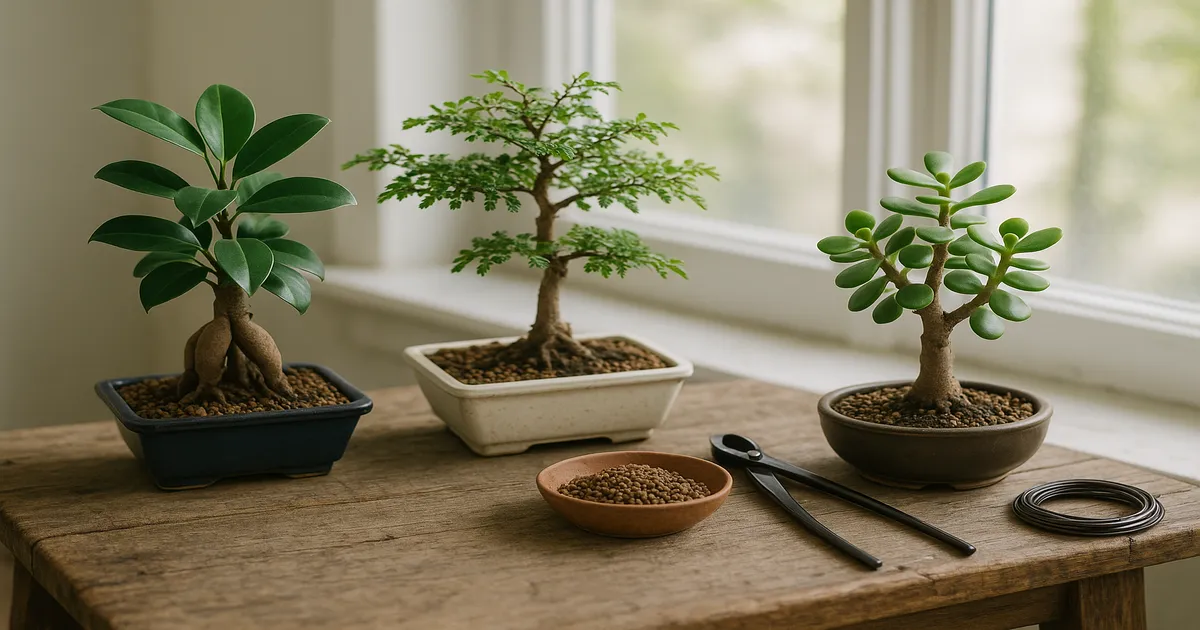
Species that fit this profile: Ficus (F. retusa, F. microcarpa, F. ginseng), Carmona retusa (Fukien Tea), Serissa foetida (Snow Rose), Schefflera arboricola (Dwarf Umbrella Tree), Crassula ovata (Jade), and Portulacaria afra (Elephant Bush).
Temperate species — junipers, maples, pines — need sustained temperatures below 40°F (4°C) for winter dormancy. Without that rest period, they exhaust their energy reserves and die, usually within one to two years indoors. If you own one of these trees, it needs to live outside year-round in your climate zone.
Chinese Elm (Ulmus parvifolia) is a gray area. It’s semi-deciduous and can adapt to indoor conditions in warmer climates, but it performs best with a cool winter rest. Treat it as an outdoor tree unless you’re in Zone 9 or warmer.
Species Profiles: Which Indoor Bonsai Is Right for You?
Ficus is the go-to recommendation for beginners. It tolerates lower light than almost any other species, bounces back from irregular watering, and responds well to hard pruning. When you move it or change its light conditions, it may drop leaves — but it almost always recovers. Minimum temperature: 55°F (13°C). Note that F. ginseng is heavily marketed for its dramatic bulbous roots but is often grafted with mismatched foliage; F. microcarpa and F. retusa are better choices for long-term development.
Carmona retusa produces small white flowers and red-to-black berries simultaneously, making it genuinely beautiful as a houseplant. It develops excellent fine branching and responds well to clip-and-grow styling. The catch: it’s sensitive to drafts, temperature swings, and overwatering. Minimum temperature: 59°F (15°C). Not the best choice for complete beginners.
Serissa foetida produces masses of tiny white flowers and develops attractive flaky gray bark, but bonsai practitioners half-jokingly call it “the tree of a thousand stars and a thousand problems.” It will drop leaves at the slightest provocation — a move to a new room, a cold draft, irregular watering. If your home environment fluctuates, start with Ficus instead.
Schefflera arboricola is arguably the most light-tolerant true indoor bonsai, surviving at 800–1,500 lux where other species would struggle. It grows quickly, responds aggressively to pruning, and develops impressive aerial roots in humid conditions — a strong choice for rooms without direct sun.
Jade (Crassula ovata) and Portulacaria afra are ideal for dry homes with occasional missed waterings. Jade develops a thick, cork-like trunk rapidly and can live for decades. Portulacaria has smaller leaves and more flexible branches, making it slightly more versatile for styling. Neither develops ultra-fine ramification, but both are nearly indestructible if you don’t overwater them.
Species Comparison Table
| Species | Beginner-Friendly | Min. Temp | Min. Light | Key Weakness |
|---|---|---|---|---|
| Ficus spp. | ★★★★★ | 55°F (13°C) | 1,000–2,000 lux | Leaf drop after moves |
| Schefflera arboricola | ★★★★☆ | 50°F (10°C) | 800–1,500 lux | Fast growth needs frequent pruning |
| Crassula / Portulacaria | ★★★★★ | 40°F (4°C) | 3,000–5,000 lux | Overwatering kills quickly |
| Carmona retusa | ★★★☆☆ | 59°F (15°C) | 2,000–3,000 lux | Drafts and temperature swings |
| Serissa foetida | ★★☆☆☆ | 50°F (10°C) | 2,000–3,000 lux | Drops leaves under any stress |
Light: The Most Underestimated Factor in Keeping an Indoor Bonsai Alive
How Much Light Do Indoor Bonsai Actually Need?
Most indoor environments are far darker than they look. Your eyes adapt; cameras and lux meters don’t. A spot that feels “bright” to you might measure 300–500 lux — enough to read by, but not enough for a bonsai to thrive.
- Survival minimum: 1,000–1,500 lux (3–5 feet from a bright window)
- Healthy maintenance: 2,000–3,500 lux (within 2 feet of a south- or west-facing window)
- Vigorous growth and flowering: 5,000–10,000+ lux (direct sun through glass or high-output grow lights)
Window priority runs South > West > East > North in the Northern Hemisphere. North-facing windows rarely provide enough light for any bonsai species. East windows work for Schefflera and Ficus but fall short for Carmona, Serissa, and Jade. One practical note: standard window glass reduces light intensity by 30–50%, and UV-filtering or tinted glass cuts it further. Position the tree close to the glass, not across the room from it.
Measuring Light and Using Grow Lights
A dedicated lux meter costs $15–30 and is the most reliable tool. (Dr.Meter LX1330B) Smartphone apps like Lux Light Meter or Photone work reasonably well as a free alternative. Take readings at canopy level, at the same time of day you’d normally have the tree positioned.
If your windows can’t deliver enough light, full-spectrum LED grow lights are the practical solution. Look for panels rated across the 400–700nm PAR range. (Mars Hydro TS600) Target 15,000–30,000 lux at canopy level, run lights for 12–16 hours per day on a timer, and position the panel 6–18 inches from the canopy — then verify with a lux meter and adjust.
Once nighttime temperatures consistently exceed 55°F (13°C), move your tropical bonsai outside. Outdoor light reaches 50,000–100,000+ lux, dramatically more than any indoor setup. The improvement in vigor, leaf density, and overall health is remarkable. Bring trees back inside before nights drop below 55°F in autumn.
Temperature, Humidity, and Soil: Getting the Foundations Right
Temperature Ranges and Hidden Hazards
Most tropical bonsai are comfortable in the same range humans prefer — 65–80°F (18–27°C). Minimum temperatures to know:
- Ficus: 55°F (13°C); leaf drop below 50°F (10°C)
- Carmona: 59°F (15°C); very sensitive to cold
- Serissa / Schefflera: 50°F (10°C)
- Jade / Portulacaria: Tolerates down to 40°F (4°C) when dormant
Window glass in winter can be 10–20°F (6–11°C) colder than room air — keep foliage from touching the pane. Forced-air heating vents create hot, desiccating microclimates, so never position a bonsai directly above or beside one. A 5–10°F (3–6°C) drop at night is actually beneficial; swings larger than 15°F (8°C) are where problems begin.
Humidity: Why It Matters and How to Raise It
Forced-air heating drops indoor winter humidity to 20–40% — well below the 50–70% that most tropical bonsai prefer. Over weeks you’ll notice browning leaf tips, leaf drop, and spider mite infestations, which thrive in dry air.
Three practical fixes:
- Humidity tray: Fill a shallow tray with pebbles and water; sit the pot above the waterline. Adds roughly 5–10% humidity locally.
- Room humidifier: The most effective solution, raising ambient humidity throughout the space. (Levoit Classic 300S)
- Plant grouping: Clustering plants together creates a shared humid microclimate through transpiration.
Carmona and Serissa are the most sensitive — below 40% relative humidity, expect leaf drop and tip dieback.
Soil: Why Potting Mix Kills Bonsai
Regular potting mix retains far too much moisture, compacts over time, and starves roots of oxygen. Bonsai roots need a medium that drains completely within seconds of watering while retaining just enough moisture to sustain the tree between sessions.
The three core components are akadama (fired Japanese clay granules that retain moderate moisture), pumice (highly porous volcanic glass that drains freely and promotes root branching), and lava rock (dense volcanic basalt with excellent cation exchange capacity). Use 3–5mm particle size for all three. (Bonsai Jack Inorganic Bonsai Soil)
Recommended ratios by species:
| Species | Akadama | Pumice | Lava Rock |
|---|---|---|---|
| Ficus spp. | 40% | 30% | 30% |
| Carmona / Serissa | 50% | 25% | 25% |
| Schefflera | 33% | 33% | 33% |
| Jade / Portulacaria | 20% | 40% | 40% |
You can add up to 10% fine composted pine bark for Carmona or Serissa if you want slightly more moisture retention.
Watering, Pruning, and Repotting
How to Water Correctly
Never water on a fixed schedule. Instead, check the soil using one of these methods:
- Finger test: Press your finger into the soil to the first knuckle. Water when it feels barely moist to dry.
- Chopstick method: Insert a dry wooden chopstick 1–2 inches into the soil. If it comes out with moist particles clinging to it, wait.
- Weight method: Lift the pot right after watering and memorize how it feels. Water when it feels noticeably lighter.
When you do water, pour until it flows freely from the drainage holes, wait five minutes, then water again. The second pass ensures complete penetration, especially in akadama-heavy mixes that can initially repel water. Use room-temperature water — cold tap water can shock tropical roots. If your tap water is heavily chlorinated, let it sit 24 hours or use filtered water.
| Overwatering Signs | Underwatering Signs |
|---|---|
| Yellowing lower/inner leaves | Brown, crispy leaf edges and tips |
| Soil stays wet for 7+ days | Soil pulls away from pot edges |
| Fungus gnats present | Pot feels very light |
| Wilting despite wet soil | Leaves curl inward or feel papery |
Pruning: Maintenance and Structure
Once new shoots extend 2–4 nodes beyond the established silhouette, cut back to 1–2 leaves or nodes. Do this consistently and you’ll develop dense, fine branching rather than long, leggy growth. Tropical species can be pruned year-round but respond fastest during active growth.
For structural work — removing entire branches to define the design — use concave cutters to create a slightly hollow wound that heals flush with the trunk.
Species-specific notes:
- Ficus: Tolerates hard pruning and back-budding readily. Cut boldly.
- Carmona: Prune lightly and consistently rather than severely.
- Schefflera: Grows fast — check it regularly and prune often.
- Serissa: Prune gradually. Hard pruning combined with any other stress can trigger significant leaf drop.
For wiring, aluminium wire is appropriate for most indoor species. Wrap at a 45-degree angle using wire roughly one-third the diameter of the branch. Check every 2–4 weeks — tropical species grow quickly and wire can bite into bark faster than you expect. Remove wire by cutting it in sections rather than unwinding, which risks snapping branches.
Repotting: When and How
Repot when you see roots circling the inside of the pot or emerging from drainage holes, water pooling on the surface, or declining vigor despite good care. Akadama breaks down over 2–3 years and loses drainage capacity, so most indoor bonsai need repotting on that cycle regardless of root behavior.
Late spring to early summer is ideal — the tree is in active growth and recovers quickly. Avoid repotting in winter.
Steps:
- Remove the tree from its pot and gently comb out the root mass with a root hook or chopstick.
- Inspect roots — healthy roots are white to tan and firm; remove any that are black or mushy.
- Prune up to one-third of the root mass, prioritizing thick downward roots over fine feeder roots.
- Place fresh bonsai soil in the pot, position the tree, and work soil into the root mass with a chopstick to eliminate air pockets.
- Water thoroughly and keep the tree out of direct sun for two to three weeks while it recovers.
Frequently Asked Questions
Why is my indoor bonsai dropping leaves? Leaf drop is most commonly triggered by a sudden change in light or temperature — moving the tree to a new room, a cold draft from a window, or the heating coming on for the first time in autumn. Check that the tree is getting at least 1,000 lux, that temperatures aren’t dipping below its minimum, and that the soil isn’t staying wet. Ficus and Serissa are the most prone to stress-related leaf drop, but both recover once conditions stabilize.
How often should I water my indoor bonsai? There is no universal schedule. Watering frequency depends on species, pot size, soil mix, temperature, and season. In summer a small pot in a warm room may need water daily; in winter the same tree might go four or five days between waterings. Always check the soil before watering using the finger test, chopstick method, or pot weight.
Can I keep a bonsai alive indoors without a grow light? Yes — if you have a south- or west-facing window that receives several hours of direct sun and you position the tree within two feet of the glass. If your windows face east or north, or if the tree is set back from the glass, a grow light is not optional; it’s the difference between a tree that survives and one that slowly declines.
How do I know if my bonsai needs repotting? Look for roots circling the pot interior or pushing out of drainage holes, water that pools on the surface rather than draining quickly, or a general loss of vigor despite correct watering and light. As a rule of thumb, repot every two to three years even if the tree looks healthy, because akadama breaks down and loses its drainage capacity over that period.
What is the easiest indoor bonsai for a complete beginner? Ficus (F. microcarpa or F. retusa) is the most forgiving choice. It tolerates lower light, irregular watering, and the occasional missed care session better than any other indoor species. Jade (Crassula ovata) is a close second, particularly for homes with low humidity or owners who tend to underwater rather than overwater.